
Books/ Common Ground
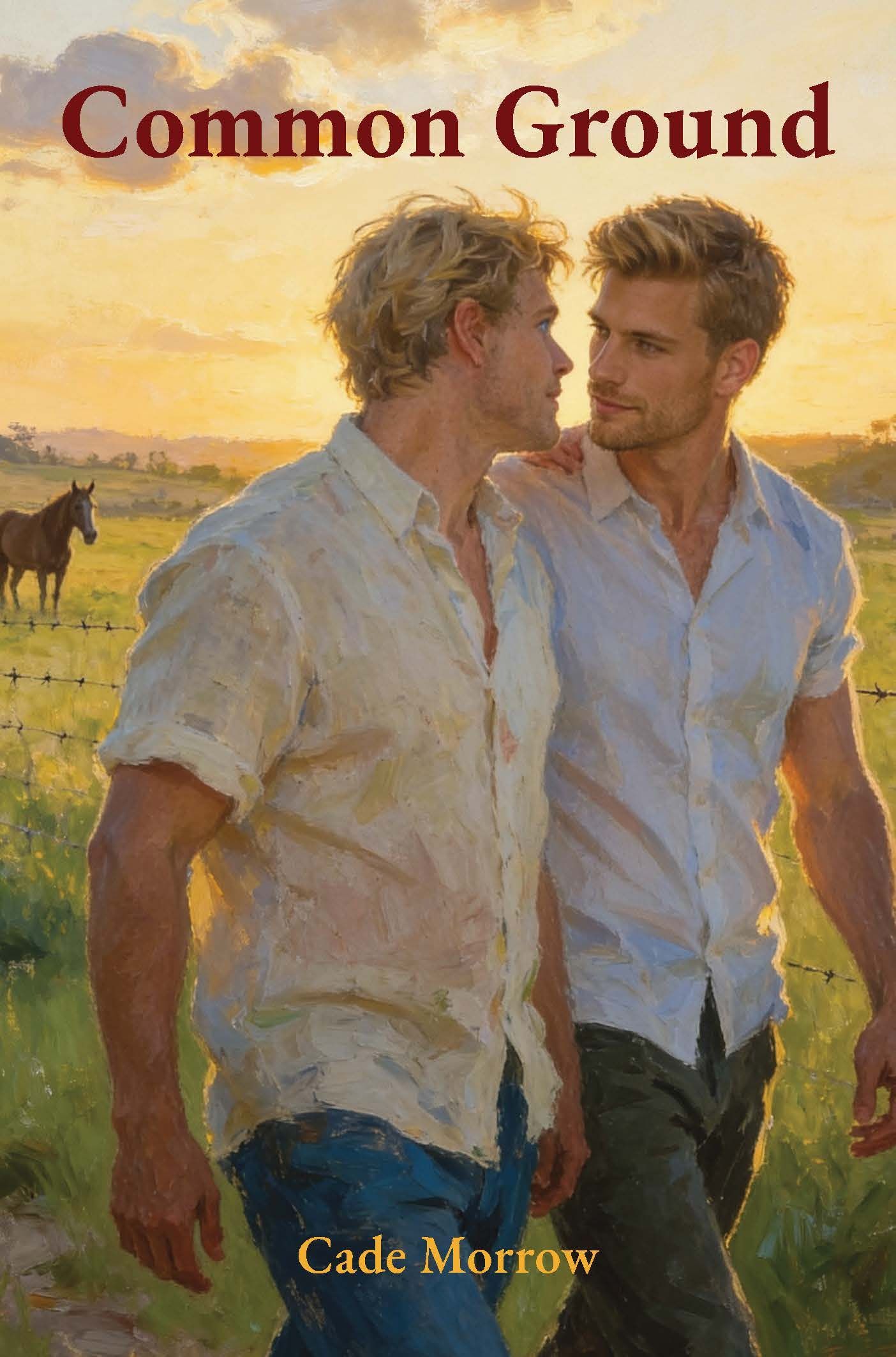
A Standalone Novel
Common Ground
Two men meet on an Iron Bowl weekend in 1995. They are told, in a hundred ways, that the life they want is not for them. They build it anyway.
Marsh Meriwether met Sumpter Hiott across a crowded fraternity house on an Iron Bowl weekend in 1995, and spent the next thirty years building a life with him: a country veterinary practice, a horse farm raised out of a wrecked and starving place in rural Alabama, a home, against everything the law, the church, and two families had arrayed against them. A tender, plainspoken novel about the home you build when no one will deed you one.
A Southern literary novel of rural Alabama, by Cade Morrow.
Available on Amazon.
About the book
Marsh Meriwether was twenty-one years old, carrying a folding table through a crowded fraternity house, when the rest of his life got out of a Jeep Grand Wagoneer and walked in wearing a borrowed jacket. The man was Sumpter Hiott, a careful, buttoned-down economist from the South Carolina Lowcountry, and across the thirty years that followed, the two of them would build something the world had told them, in a hundred ways, loud and quiet, that they were not allowed to have.
They build it anyway: a country veterinary practice, a horse farm raised out of a wrecked and starving place in rural Alabama, and a marriage no courthouse would grant and no church would bless, kept in the only currency the era left them. A survivorship deed. A coffee can at the end of a drive. A hand held one beat too long.
Told decades on, in the plainspoken, unhurried voice of a man who has earned the right to say the truest things plainly, Common Ground is a tender and quietly triumphant novel about love held in the open at last, about chosen family, and about the long, ordinary work of making a home on ground that was never supposed to be yours.
Read the opening
Chapter 1
Blocking the Plate
The Tuscaloosa cars came up Magnolia a little after six on Friday, four of them riding low with brothers and coolers, and by the time they finished parking on the grass the Rho house was already too loud for the fire marshal and smelling of keg foam and somebody’s failed attempt at chili. Russ had wedged the keg into a galvanized feed tub of ice on the back porch, which was the one job he had been given, and he stood over it with a hand pump and the gravity of a man administering a sacrament. I was twenty-one years old. I had a catcher’s knees and a B in organic chemistry and no idea that the rest of my life was about to get out of a Jeep Grand Wagoneer in front of the house and walk in wearing a borrowed jacket.
I want to be honest about the order of things, because I have had a great many years to get the order straight and I am not going to dress it up. I did not know his name yet. I did not know he was from a town I couldn’t have found on a map, or that his people had four hundred years of Carolina behind them, or that I would spend the next three decades learning the inside of a man who priced every word he said in daylight and saved exactly one for the dark with me. I knew none of that. What I knew, the first half second, before he turned, before either of us said a word, was that the room had a center now that it had not had a minute before, and the center was him, and everything in me had quietly tilted toward it the way water finds the low place in a floor. I have been told that is not how it happens. It is. It happened to me at twenty-one with a folding table in my hands, and I never once, in all the years after, had cause to revise the report.
It was the Iron Bowl, the first one in Auburn in two years, and the visiting brothers had come in the door hollering and got hollered at, which is the protocol, and they wore crimson under their jackets like a dare, and somewhere in the crush of all that I was carrying a folding table through the front room when I saw him.
What the book is about
You can inherit land. You cannot inherit a home.
Common Ground sits in the place-rooted tradition of Southern literary fiction, but where so many stories of queer love in that world end in loss, this one is about the getting and the keeping. Its real subject is the home two people build when the institutions around them refuse to build it for them, and the daily, unspectacular choosing that a home is actually made of. It is a book about land and what it can and cannot pass down; about two mothers who love the same way from opposite distances; and about a love that came up in a time and a place that had no name for it that it would say out loud, and lived to be said in daylight. Above all it is the answer to every story in which men like these do not get to stay. Here, they stay.
Book details
- Author Cade Morrow
- Format Standalone novel
- Genre Southern literary fiction, LGBTQ+ fiction
- Setting Alabama, from 1995
- Length About 88,000 words, 12 chapters
If you like
Place-rooted American literary fiction in the unadorned tradition of Kent Haruf and Wendell Berry, for everyone who ever wished the men in those mountain-and-prairie love stories had gotten to keep the land and each other. Common Ground is the version where they do. Adult literary fiction with gay protagonists, a hopeful love story about chosen family and building a home, not genre romance.
More from Cade Morrow
Common Ground stands on its own. If you want more of the South in Cade's pages, read Someday, a quiet novel of south Mississippi, or start the Ebb Tide series on the Gulf Coast with Still Waters. Browse all of Cade's novels.
About the author
Cade Morrow writes quiet, deeply felt literary fiction set in the small towns and back roads of the American South, in a plainspoken voice concerned with memory, place, and the private weather of ordinary lives. A son of the Deep South, he writes from the heart, telling stories of life in the LGBTQ+ community, some drawn from his own experience, others from the compassionate observation of the people around him. Read more about Cade.
Come home to Common Ground.
Find it on Amazon