
Books/ Someday
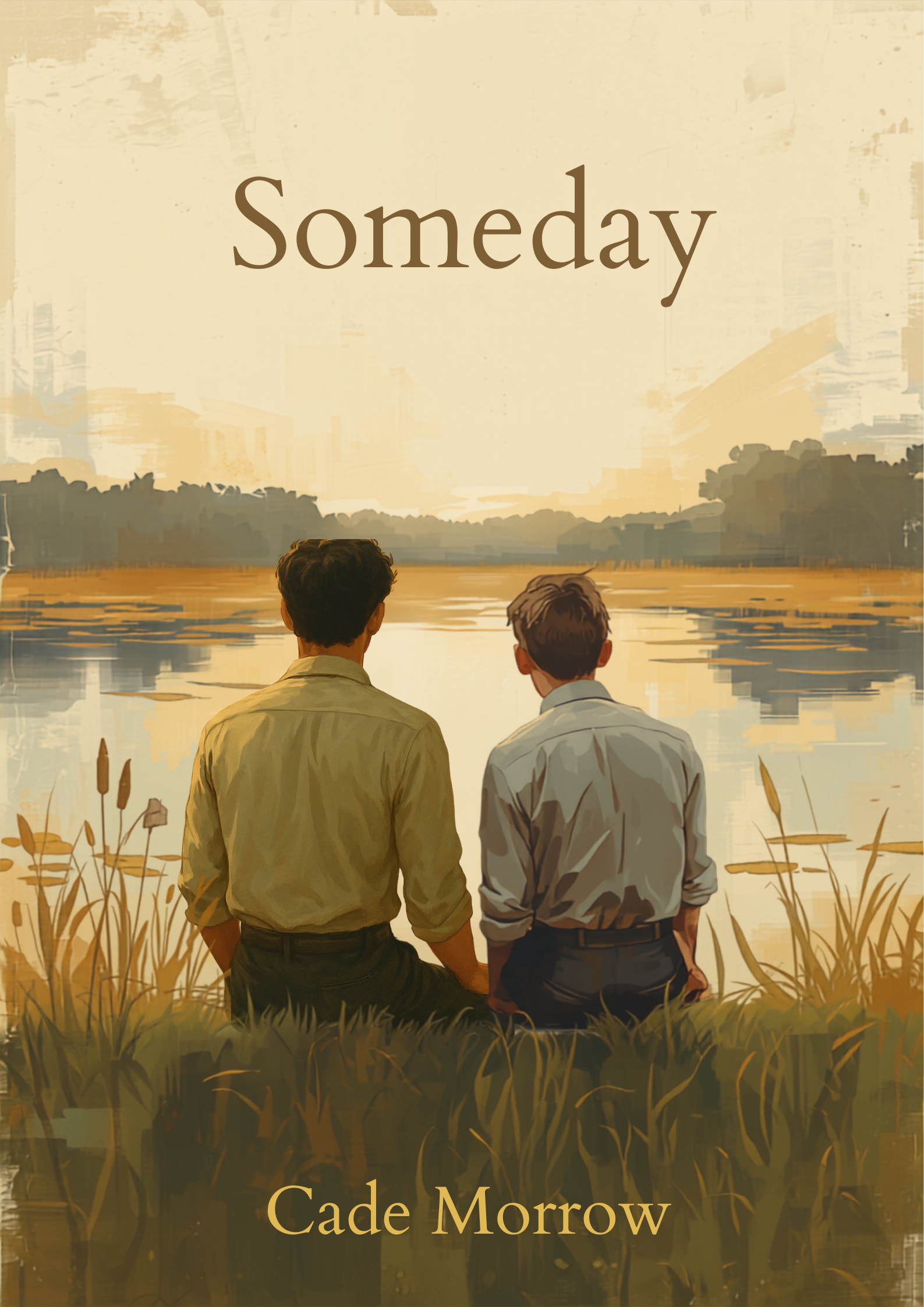
A Standalone Novel
Someday
Steven Greene grew up beside a boy named Austal Moorer. Sixty years later, he is still keeping him.
Steven Greene grew up in a small south Mississippi town, beside a boy named Austal Moorer, and across the whole long reach of his life he never stopped loving him. Now, looking back, he sets the story down without flinching: the slough, the keeping, the distance, the cost of a love held close for sixty years. A quiet, devastating novel about memory, belonging, and the lives we carry inside us.
A Southern literary novel of south Mississippi, by Cade Morrow.
Available in print. eBook to follow.
About the book
For most of his long life, Steven Greene has kept things. A gray skipping-stone from a boyhood morning at the slough. A fishing lure a friend once went under the water for and handed up to him to keep. A windowsill's worth of small objects that, set in their right order, tell the one story he has ever needed to tell: the story of Austal Moorer, the boy he grew up beside, and the love that ran like a low current beneath every year that followed.
Now, old enough to say the truest things without flinching, Steven sets that love down on the page. Someday is the account of a life measured against its one fixed point: a meditation on the places that form us, on the distance between the life a person lives and the life he carries folded up inside him, and on what it finally costs, and is worth, to let another soul all the way in.
Told in the plainspoken, unhurried voice of the rural South, Someday is a tender and quietly shattering novel about memory, longing, and the long work of becoming who you are.
Read the opening
Chapter 1
What I Kept of Him
Austal could skip a stone eight times across the slough and I had never in my life got past four, and that morning he was running the score up out loud, narrating his own greatness for an audience of one. Eight, he hollered down at me on the mud, you see that, Greene? Eight. You ever once in your life seen eight? I told him I had not, and that nobody liked a show-off, and he allowed as how that was probably so, cheerful about it, and bent after another flat one. He had a whole school he could have been showing off for, and instead he was down at the slough by seven in the morning, where the only eyes on him were mine. The slough ran the color of strong tea and threw the early light around in pieces. It was August, the kind that arrives already used up, a shower come through before daylight and the air left thick enough to chew, and the black-eyed susans along the bank had bees in them working the way they work, methodical and certain of the job. I was down on the mud hunting flat rocks for him to beat me with. He hit eight and turned around to be sure I had seen it. I had. I always had. I kept a standing account of the things Austal did that nobody was there to witness but me, and I felt the grin he gave me arrive somewhere under my breastbone and set up there for the day.
The slough was ours the way a place gets to be a child’s, meaning it belonged to a dozen other people on paper and to nobody at all in the only ledger that counted, the one kept by whoever loved a place most and got to it earliest. We had found it a couple of summers back, following a runoff ditch off the county road until it opened out into this, a slow brown elbow of water the river had quit using and left behind, ringed in willow and titi and the kind of reed that will cut you if you take it for granted. By that August we had a path worn to it that nobody else could see, and names for the parts of it that would have meant nothing to another living soul. A boy needs one place in the world that answers to him. The slough was mine, and it was Austal’s, and the fact that it was the same place was the whole of my luck that summer.
There was one stone in my pile I did not give him. It was gray and flat and worn down to nothing on its edges, the best skipper I had found all summer, and instead of handing it over to be thrown out to the middle and lost I put it in my pocket. I did not decide anything. A boy puts a stone in his pocket the way water finds the low place, with no argument in it. I only knew I could not stand to watch that particular one go out and not come back.
What the book is about
Someday sits in the plainspoken, place-rooted tradition of Southern literary fiction, but its real subject is interior: the gap between the self a person shows the world and the one he guards, and the way a single love can become the organizing fact of an entire life. It is a book about keeping (objects, secrets, people, the past) and about a queer love that came up in a time and a place that had no name for it that it would say out loud. Above all it is about an ordinary life taken seriously, rendered with enough tenderness and precision that its quiet turns land like blows.
Book details
- Author Cade Morrow
- Format Standalone novel
- Genre Southern literary fiction, LGBTQ+ fiction
- Setting A small town in south Mississippi
- Length About 59,600 words, 12 chapters
If you like
Place-rooted American literary fiction in the unadorned, interior tradition of Kent Haruf and Marilynne Robinson, here turned toward a love the era kept unspoken. Adult literary fiction with a gay protagonist, not genre romance. Readers of quiet Southern novels about memory, small-town life, and unspoken love will feel at home.
More from Cade Morrow
Someday stands on its own. If you want more of the Gulf Coast South, try the Ebb Tide series, which begins with Still Waters, or browse all of Cade's novels.
About the author
Cade Morrow writes quiet, deeply felt literary fiction set in the small towns and back roads of the American South, in a plainspoken voice concerned with memory, place, and the private weather of ordinary lives. A son of the Deep South, he writes from the heart, telling stories of life in the LGBTQ+ community, some drawn from his own experience, others from the compassionate observation of the people around him. Read more about Cade.
Keep Steven's story.
Find it on Amazon