
Books/ The Weight of Fine Things
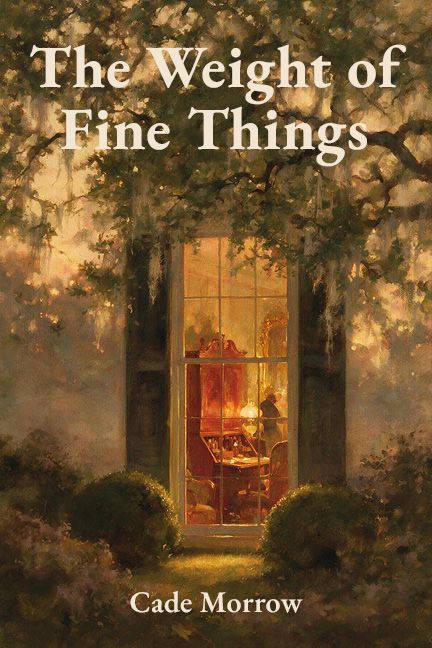
A Standalone Novel
The Weight of Fine Things
He can tell you the provenance of every object in that house. He cannot tell one living person what he wants.
In 1990, Clyde Causey is twenty-five, working the night desk at a hotel in Natchez, Mississippi, and renting a room. Then a lawyer tells him that Roberta Dunbar, a distant relative who sent one Christmas card a year and little else, has left him her house on the bluff and everything in it. He has no idea why. What follows is thirty years of a life built around fine things: a trade, a reputation, a house full of objects whose histories he can recite to the inch, and four men he could not hold on to.
A Southern literary novel of Natchez, Mississippi, by Cade Morrow.
Available on Amazon.
About the book
In 1990, Clyde Causey is twenty-five years old, working the night desk at a downtown hotel in Natchez, Mississippi, and renting two rooms in a boarding house. Then a lawyer calls him in and tells him that Roberta Dunbar, the distant relative the family called Aunt Bertie, who sent one stiff Christmas card a year with a printed robin on it and was otherwise a rumor, has left him her house on the bluff. The house, the trust, the twelve rooms, and every object in them.
She left no letter. She left no reason.
What follows is thirty years of a life built around fine things. A trade learned sideways from a woman on Canal Street who never once called it teaching. A reputation that finally opens the doors that were closed to a boy from the Causey street. And four men across four decades: the dealer who taught him the business, an architect, one who was too young, and one, at fifty, who almost stayed.
Clyde can tell you where every piece in that house came from, who owned it, what was done to it and in what year, and how he knows. He is telling you all of this himself, at fifty-eight, in his own words, and he is a scrupulously honest man about everything except the one thing he has never been able to say out loud.
The Weight of Fine Things is a novel about the difference between wanting a thing and being able to hold it. About recognition, inheritance, and the long private cost of arranging a life so that nothing in it can ever be taken away.
Read the opening
Chapter 1
The street ended in a chain-link fence, and past the fence the ground gave out into river bottom, willow scrub and black mud that smelled of fish even in January. That was where the Causey street stopped. It did not go anywhere, and it was not meant to. You could stand at the dead end and look out at the willows and the brown water beyond them and see that the city had drawn a line and set us under it. Most days nobody stood there to look. You do not study a thing you already live inside.
We lived in dirt. Not poverty, said soft and from a distance, the word a church bulletin uses. Dirt. The yards had given up on grass and gone to bare ground, swept by feet and rain and the corn-straw brooms our mothers ran over them on Saturdays until the ground shone like a poured floor. The last hundred feet of road was dirt too, where the city's asphalt decided it had come far enough east and quit. In July the ground rose in a red film and settled on the porch rails, the windowsills, the white of a clean shirt, the backs of our hands. You wiped it. It came back. After a while you let it stay.
There were nine houses on our side and seven on the other, frame houses set close, most owned by the families that had always owned them, because ownership was the one form of standing the street allowed and the people there held it the way you hold the last dry match. A church at the corner that was a house with the front room knocked through, folding chairs and a piano nobody had tuned since the war. A store at the other corner that sold single cigarettes and white bread and bologna that came in a red rind, and would carry you on a book until Friday if Mr. Pernell knew your mother. I could draw the whole of it now with my eyes shut. I could put every screen door back on its slapping hinge.
What the book is about
I did not want to live in them. That is the thing I have never been able to make anyone from the street understand. I wanted to understand them.
Told in retrospective first person by Clyde Causey, an antiques dealer in Natchez, The Weight of Fine Things is a standalone literary novel that unfolds as a spoken account, with the careful formality of a man who learned to speak carefully because speaking carelessly once cost him something. Interleaved through it are entries from a journal kept by the woman who left him the house, a second voice that sees the same events from an angle Clyde does not have for most of his life. At its center is a question the book takes seriously and refuses to answer cheaply: what does it mean to be recognized by someone, and what happens to a person who is recognized too late? It is a novel about class as much as about love. Clyde spends his life buying his way toward rooms he was not born into, and the book is unsentimental about what that purchase does and does not buy.
Book details
- Author Cade Morrow
- Format Standalone novel
- Genre Southern literary fiction, LGBTQ+ fiction
- Setting Natchez, Mississippi
- Length About 92,000 words, 13 chapters
If you like
Readers of Kazuo Ishiguro's The Remains of the Day , for its scrupulous narrator who gives a full and honest account of everything except the one thing that mattered, and of Sarah Winman's Still Life , for objects, provenance, and chosen family. In the Southern literary register of Ron Rash, Larry Brown, and Silas House, with the queer literary reach of Michael Cunningham and Alan Hollinghurst. Literary, restrained, and unsentimental about class, not genre romance.
More from Cade Morrow
The Weight of Fine Things stands on its own. If you want more of the South in Cade's pages, read Someday, a quiet novel of south Mississippi, Brackish, a novel of three families and one fish camp in the Alabama delta, Common Ground, a love story set in rural Alabama, or start the Ebb Tide series on the Gulf Coast with Still Waters. Browse all of Cade's novels.
About the author
Cade Morrow writes quiet, deeply felt literary fiction set in the small towns and back roads of the American South, in a plainspoken voice concerned with memory, place, and the private weather of ordinary lives. A son of the Deep South, he writes from the heart, telling stories of life in the LGBTQ+ community, some drawn from his own experience, others from the compassionate observation of the people around him. Read more about Cade.
Come up to the house on the bluff.
Find it on Amazon