
Books/ Sourwood
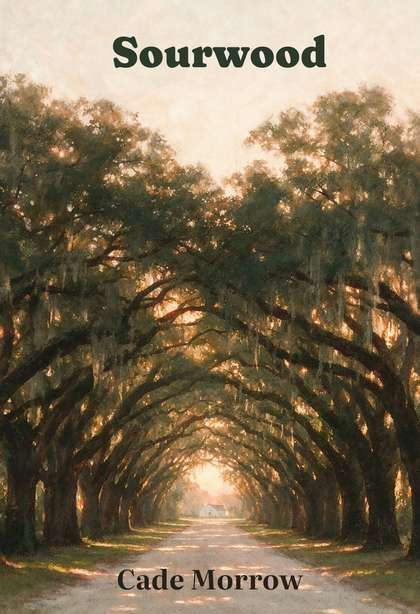
A Standalone Novel
Sourwood
A New York dealmaker inherits his father's twenty-two thousand acres of coastal Georgia, and the one thing on it he cannot put a price on.
August "Gus" Calder got out of southeast Georgia the first chance he had. Now his father is dead, the Reach is his, and a single clause in the will turns the easy sale into a trap. To leave, he has to stay. A luminous novel of inheritance, the working South, and the loves we are never given the words for.
A Southern literary novel of the Georgia coast, by Cade Morrow.
Available on Amazon.
About the book
August Calder is very good at leaving. He left the Altamaha at eighteen, left the flattened vowels and the family land and the boy he almost knew, and built a life in New York out of clean numbers and cleaner exits. He can walk a room and price every person in it. He has spent a decade making sure home has no language that can reach him.
His father's death should have been the last transaction. Gus flies down to bury Emmett Calder and sell the Reach, twenty-two thousand acres of pine, blackwater, and worked ground his family has held since before the war. But the will has a clause his father built and left waiting, and it will not let the place be sold intact. To get free of the land, Gus has to live on it. And living on it means Roan Ott, the beekeeper whose bees cross the boundary line as if it were never drawn, and whose quiet is the one thing Gus cannot appraise, or resist.
A New York summer would have flipped the estate. A Georgia year takes Gus apart instead. He hauls water in a drought. He watches a man mend a fence that fences nothing. And in his father's ledgers, kept in a flat, unhurried hand at a loss no accountant would allow, he begins to read a story the old man never once said out loud.
Sourwood is a novel about inheritance and the working South, about grief and dignity that refuse to cancel each other out, and about how the deepest love is so often the kind that was never allowed a word, the kind you can only find by learning to read what a person kept.
Read the opening
Chapter 1
The deal closed at four, and for the next hour I was the most agreeable man in Manhattan. It was the last good day of the old life, though I would not know that for a while, the way you never do. I have never told this straight through to another person, and out loud it goes differently, so bear with me where I circle.
People think charm is a mood you’re born into. It isn’t. It’s a trade, and I had worked at it as my father worked weather, until I could come into a glass room forty floors up and read the whole of it before the door sighed shut behind me: where the exits were, who held the leverage and who only believed he did, what each man at the table wanted and how much it was costing him to keep his face still about it. I shook the hands. I gave them the grin first, the crooked one, the one that gets there ahead of me and holds the door, and I had used it so long and so well that I had stopped being able to tell you where it left off and I began. I gave them their own numbers back in a voice that made the numbers sound like their idea. A clean basis, I said. A ten-year hold. Real upside for the patient money. I meant every word while I said it, because meaning it was part of the trade too, and I was very good at the trade. It was the thing I had made of myself in the place of everything I’d left, and it fit me beautifully, and I had stopped noticing that a thing can fit a man beautifully and still not be his. I had the hair cut every three weeks. I had the suit made. I had a tan that a certain kind of man in that city took for weekend places, and I let him read it that way, and I did not tell him it came off a river.
By the time I came down to the street the light had gone long and copper on the avenue and my phone had filled as it always filled. The Oxford lot kept a thread running that had not gone dark in ten years, and it had been going all afternoon while I closed my deal. Freddie had sent a photograph of a sailboat he could not begin to afford, moored somewhere the water was a blue we did not get in New York, under a message that said come home to civilisation, you rustic, before the swamp reclaims you. Priya had put two words under it that I won’t repeat, because they were for Freddie and they were perfect. Theo was in the middle of it agreeing with both of them at once, which was Theo’s whole art. I stood on the pavement in the good coat and thumbed up through the warmth of people who had known me since I was nineteen, and that thread was the best of my life, and I mean that without a shadow on it. Julian was the shadow, and he was higher up the screen.
What the book is about
Some love never gets said. It goes into the work of a person's hands.
Sourwood is a standalone work of contemporary literary fiction set along the Altamaha River in coastal southeast Georgia, among longleaf pine, river swamp, and the crossroads towns that work them. It is told in the first person by Gus, a man who has spent his life reading the value off of everything and has to learn, late, to read something harder. The novel is a slow, present-day love story between two men, a meditation on stewardship and what a family leaves in the land, and a study of the particular dignity of the working South. What the land has been keeping is the novel's to tell.
Book details
- Author Cade Morrow
- Format Standalone novel
- Genre Southern literary fiction, LGBTQ+ fiction
- Setting The Altamaha River corridor, coastal southeast Georgia, present day
- Length About 103,000 words, 28 chapters, 317 pages
- Audience Adult
If you like
Readers of Annie Proulx's Brokeback Mountain , for the encoded love in a hard rural world, and Marilynne Robinson's Gilead , for inheritance and a father's hidden interior. In the quiet rural register of Ron Rash, Kent Haruf, and Wendell Berry's Port William novels, where a place is worked and loved across a lifetime. Literary first, not genre romance.
More from Cade Morrow
Sourwood stands on its own. If you want more of the South, try Common Ground, a love story set in rural Alabama, Brackish, a novel of three families and one fish camp in the Alabama delta, or The Weight of Fine Things, a Natchez novel of an inherited house, or start the Ebb Tide series on the Gulf Coast with Still Waters. Browse all of Cade's novels.
About the author
Cade Morrow writes quiet, deeply felt literary fiction set in the small towns and back roads of the American South, in a plainspoken voice concerned with memory, place, and the private weather of ordinary lives. A son of the Deep South, he writes from the heart, telling stories of life in the LGBTQ+ community, some drawn from his own experience, others from the compassionate observation of the people around him. Read more about Cade.
Some love never gets said.
Find it on Amazon