
Books/ The King's Hyacinth
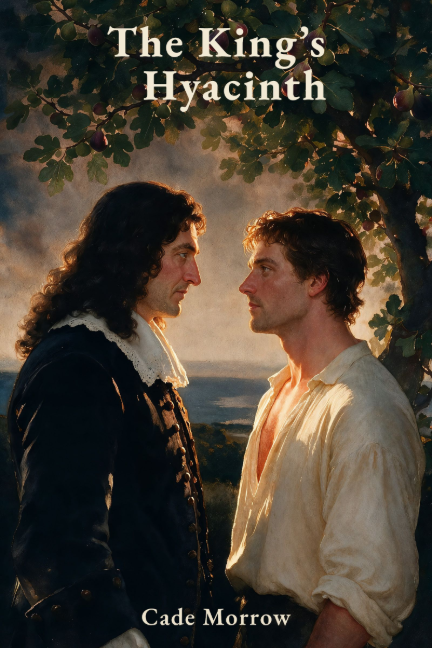
A Standalone Novel
The King's Hyacinth
He wrote the official record of a man he was never allowed to love. This is the other one.
In the last years of his life, a French Marine clerk sets down the private account he never filed: the record of Jean-Baptiste Le Moyne de Bienville, founder of Louisiana, and of a love he carried for him across forty years and never once spoke aloud. A quiet, devastating novel of the American South's oldest silences.
A historical literary novel of French colonial Louisiana, by Cade Morrow.
Available on Amazon.
About the book
Florent-Hyacinthe de Cazaubon came to the Ministry of the Marine with a good name and no fortune, a courtier's polish, and no idea that the posting he was about to take would become the whole of his life. He was sent to keep the Crown's records and write the dispatches home for a difficult young Canadian officer bound for a coast no one in Paris had yet decided how to describe. He followed that officer out into the rain, and he never really came back.
For forty years Florent made Jean-Baptiste Le Moyne de Bienville legible to a kingdom an ocean away. He turned raw colonial deeds into language Versailles would fund and forgive, and he kept two records as he did it: the official dispatch, and the private one, the true one, the account no minister would ever read. He learned the short list of things that could make the founder of Louisiana go still, a failing grapevine, a fig tree, wild strawberries, a mockingbird at dusk, and he hoped, every time, to be on it.
He never learned whether he was. Some men can be read only by what they plant, and Bienville planted cities and named them all for other men.
Told in the unhurried voice of an old man writing by lamplight, The King's Hyacinth is a novel about the gap between the public monument and the private blank, about building the place you are not allowed to stay in, and about the long, patient cost of a love arranged so carefully that no one, not even its object, was ever permitted to see it.
Read the opening
Chapter 1
He died in the spring, in Paris, in a house I never saw, and I have begun this eleven times since.
The dispatch is on the table at my left hand. Twelve lines, in the hand the Ministry liked, which was a hand with no man standing behind it. Every word of it is true. A man could read it and come away knowing that a river has a mouth and that the English were east of it, and nothing whatever about the afternoon I am trying to get down. That is not the dispatch's fault. It was never asked for the afternoon.
He came in wet. Every man who has written about him has begun with the ships, and I will get to the rain in a moment. But I have to put myself in the room first, and to do that honestly I have to say what I was that morning, which was a man carrying another man's sentences down a corridor.
What the book is about
He named the city for the Regent. He named the forts for the King. He kept for himself nothing.
The King's Hyacinth is a standalone work of literary historical fiction set in French colonial Louisiana, from the antechambers of the Ministry of the Marine in 1697 to the Gulf Coast the French were only beginning to build, and forward across the first half of the eighteenth century. Its narrator, Florent, is invented. Its central figure is not: Jean-Baptiste Le Moyne de Bienville founded Mobile and New Orleans, governed the colony on and off for some thirty-six years, and died having named a great deal for other men and kept nothing for himself. The novel occupies the silence the historical record leaves around Bienville's private life, and does not fill that silence with certainty. It builds a fully realized world around it, including the Code Noir and the enslavement the colony was built on, which the novel refuses to soften or to make beautiful. It is a love story told in the register of things that happen over decades, and a serious reckoning with what the official record costs the private one.
Book details
- Author Cade Morrow
- Format Standalone novel
- Genre Historical literary fiction, LGBTQ+ fiction
- Setting French colonial Louisiana and the Gulf Coast, 1697 onward
- Length About 90,000 words, 21 chapters
- Audience Adult. Depicts colonial slavery and the Code Noir without softening.
If you like
Readers of Kazuo Ishiguro's The Remains of the Day and Andrew Sean Greer's The Confessions of Max Tivoli , for the retrospective narrator writing his own account near the end. In the Southern literary register of Ron Rash, Larry Brown, Silas House, and Dorothy Allison, turned toward stories of men in love with men, with the emotional density of Michael Cunningham and Alan Hollinghurst set in the deep historical South. Literary first, not genre romance.
More from Cade Morrow
The King's Hyacinth stands on its own. It is the historical root of the same Gulf Coast Cade's other novels walk. Try Brackish, a novel of three families and one fish camp in the Alabama delta, Common Ground, a love story set in rural Alabama, The Weight of Fine Things, a Natchez novel of an inherited house, Sourwood, a novel of inheritance on the Georgia coast, or start the Ebb Tide series on the Gulf Coast with Still Waters. Browse all of Cade's novels.
About the author
Cade Morrow writes quiet, deeply felt literary fiction set in the small towns and back roads of the American South, in a plainspoken voice concerned with memory, place, and the private weather of ordinary lives. A son of the Deep South, he writes from the heart, telling stories of life in the LGBTQ+ community, some drawn from his own experience, others from the compassionate observation of the people around him. Read more about Cade.
Read the account he never filed.
Find it on Amazon